
Identify a Noble County Owner
Noble County ownership splits between parcel data and recorded instruments. Beacon is the fastest address-to-owner bridge. The Recorder's index is the legal-instrument check. Keep the State PIN, Tax Bill ID, or legal description as the common thread when asking who owns the same tract.
- Search the address in Beacon and open the matching parcel.
- Copy the owner name, mailing address, State PIN, and legal description.
- Search the Recorder routes by owner name, legal description, and approximate purchase date.
- Confirm that the newest deed's grantee and land description match the parcel.
A grantee receives the property in a deed. If a new deed is more recent than Beacon's card, the parcel layer may simply be awaiting its update.
Noble County Parcel Clues
An address search can fail for simple reasons. The land may have no street number, the address text may have changed, or the Assessor and Surveyor layers may use different systems. Noble County recommends switching Beacon layers when one search does not return the tract. Every parcel also carries an 18-digit State PIN. It starts with county code 57 and shows punctuation. Preserve any leading zero in an 11-digit Tax Bill ID.
The GIS Office's land ownership roster offers another route. Its rows list owner name, township and section, legal description, acreage, county IDs, instrument dates, and deed number, refreshed around mid-month as a PDF. It works best as a cross-check.
Trace Noble Owners to Deeds
The Noble County Recorder keeps deeds, mortgages, plats, easements, liens, and releases. Its online deed search reaches to 1937, and office terminals back it up when the vendor route fails or an image is unavailable online.
An address alone may not locate a deed, the Recorder FAQ warns. Use the property owner's name instead. Add the legal description and purchase date. Staff do not run title or lien searches.
Where Noble Ownership Appears
No single Noble County source answers every ownership question. Each official record has its own job and update rhythm.
| Ownership Source | What It Gives | Access |
|---|---|---|
| Beacon Assessor layer | Owner name, mailing address, situs, parcel keys | Free public portal |
| Recorder deed index | Grantor, grantee, date, legal description | Online routes and office terminal |
| GIS ownership roster | Owner, tract, acreage, IDs, deed number | Monthly PDF |
| Indiana INBiz | Entity ID, status, registered agent | Free state search |
The official Noble County Assessor page connects the ownership method to Beacon.
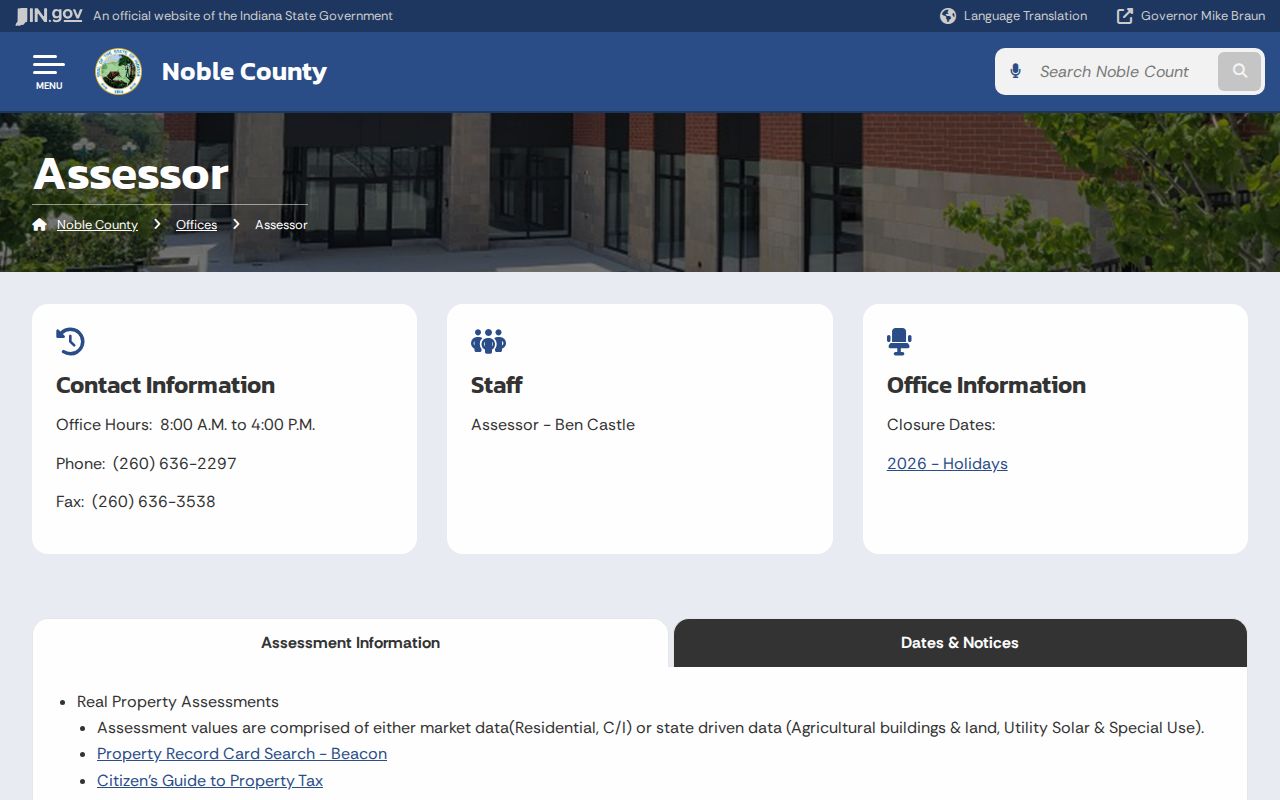
The parcel record answers the ownership question first. Deed confirmation comes second. The owner of record is not necessarily an occupant, and the assessment roll does not prove who lives at a parcel. A title professional may also need to review liens, releases, probate orders, and instruments beyond the deed.
Entity Owners in Noble County
The owner may be an LLC, trust, or estate. Search the exact wording from Beacon and the deed. Indiana's INBiz search can verify an entity ID, status, and registered agent. The agent is a contact, not the owner.
Trusts often disclose little beyond a recorded name. An estate may need a Noble County probate check followed by any later recorded conveyance. Do not substitute an officer, trustee, heir, or agent for the grantee unless the record vests title that way.
Noble Property Fraud Alerts
The Noble County Property Fraud Alert is free. It sends a notice when a document with a subscriber's name is recorded. That can flag an unexpected filing. Enrollment is a useful safeguard. The alert cannot block recording, decide who owns the land, or cover the judgments, state tax liens, and bankruptcies outside its stated scope, so the instrument itself remains the record to inspect.
Access Noble Records Offline
An online failure does not end an owner search. Public terminals sit in the Noble County Recorder's office, in the Annex at 109 N York Street in Albion. Hours run Monday through Friday, 8:00 a.m. to 4:00 p.m. The published number is 260-636-2672. Call ahead. Staff can say what name, date, or legal-description detail makes an in-person search productive.
Some records sit outside routine portal or counter service. Indiana's Access to Public Records Act gives those a written-request route. Name the instrument, parcel, approximate date, and copy wanted. It should not ask for a title history, since the law does not require an agency to create a new list it does not maintain.
Deed Clues Beyond the Name
A matching name is only one part of the method. The deed's legal description can state a subdivision, lot and block, or a tract in a township and section. Beacon may add acreage and the State PIN. When these details agree, the assessor card and the deed clearly describe the same Noble County land.
A purchase or boundary review raises the stakes. Read the releases, assignments, plats, easements, and covenants too. Those records may affect the land without changing the owner name. A recorded instrument is public evidence. Still, Recorder staff warn that an index check is not a title opinion.
Noble Mailing and Situs Addresses
A Noble County parcel carries two addresses, and each one answers a different question. The situs tells you where the land sits. The mailing address tells you where the owner of record gets tax bills. It also shows where county notices go. For vacant land, entity-held property, or an absentee owner, the two often disagree. That mismatch alone signals nothing improper. Treat the mailing address as a contact channel, never as proof of where someone lives. Indiana's Address Confidentiality Program can substitute a protected address in place of the real one. An official property records source may withhold or replace an address. Respect that limit and stop.
Resolve Conflicting Noble Owner Names
Two official sources in Noble County can list different owner names. Neither has to be wrong. Start with the dates. A deed may have been recorded after the GIS roster's monthly refresh. It may also predate a transfer update in the Assessor layer. Then match the land itself across both records. Compare the State PIN, the Tax Bill ID, acreage, township and section, subdivision, lot and block. Also compare the deed number. A shared street address is weaker proof, since one site can hold several tax tracts.
Next, figure out what role each name actually plays. Beacon lists the assessment-roll owner. A deed names a grantor and a grantee. A mortgage names borrowers and a lender, but that lender is not the property owner. A recorded release can close an old lien without moving the land. An Auditor transfer or split can also shift the administrative parcel record. That shift can happen after the deed reached the Recorder.
Entity and estate names call for one more step. Look up an LLC under its exact wording through Indiana INBiz. Do not swap in the registered agent. For an estate, check a MyCase result or a Clerk file. Either may show who held authority to act. The later deed still tells you whether the land changed hands. When the legal description fails to match, stop the public-record lookup and get a title examination. The same applies when instruments create competing claims. The county Recorder supplies records and copies, not legal advice or a title conclusion.
Confirm Noble County Copy Details
Once the right deed is pinned down, ask what proof the task truly needs. The Recorder charges per page for plain copies plus a separate certification fee. A plain image often works for personal research. A certified copy carries the custodian's authentication. Neither version guarantees clear title. Neither proves that no later instrument exists. Run the index through the current date. Keep the deed number, recording date, and legal description attached to the copy.
If the search started from a land ownership roster row, compare its instrument date against the deed image. If it started in Beacon, check the parcel card's last-sale clue and owner name. These small cross-checks keep one person's deed off a different Noble County parcel. That parcel might happen to share a street address.
Limits of Noble Owner Findings
A public record names the recorded or assessed property owner. It cannot confirm occupancy. It does not resolve every title right or expose protected addresses, and Indiana confidentiality rules may substitute an address for a protected participant.
Ownership limit. A roll name is not a title search. Use owner data for lawful property research and never to harass, target, or harm anyone.
- Owner of record
- The party carried as owner in the parcel record.
- Grantee
- The party receiving land in a deed.
- Title
- Legal rights in land, which can require more proof than an index result.
- Situs
- The physical parcel address, distinct from an owner's mailing address.