
Noble County's Owner Record
For Noble County, the Beacon property record is the quickest way to check a parcel's current owner. The Assessor and GIS Office publish it through Schneider. Each parcel carries a land ownership name. It also holds a mailing address, a situs address, a Parcel ID, and a Tax Bill ID, and each field answers a different question. The owner name is the party on the roll. Tax mail goes to the mailing address. The situs is simply the physical property location, and it may not match the mailing address at all.
| Owner Name | The person, trust, estate, or entity carried on the assessment roll |
|---|---|
| Mailing Address | The destination for tax and assessment notices |
| Situs | The street location of the Noble County parcel |
| Parcel Keys | The Parcel ID, 18-digit State PIN, or 11-digit Tax Bill ID |
| Last Sale Date | A clue for checking whether a recent transfer is reflected |
| Deed Reference | The instrument link used to verify the named grantee |
The Noble County Assessor page is the official bridge to the Beacon parcel roll.
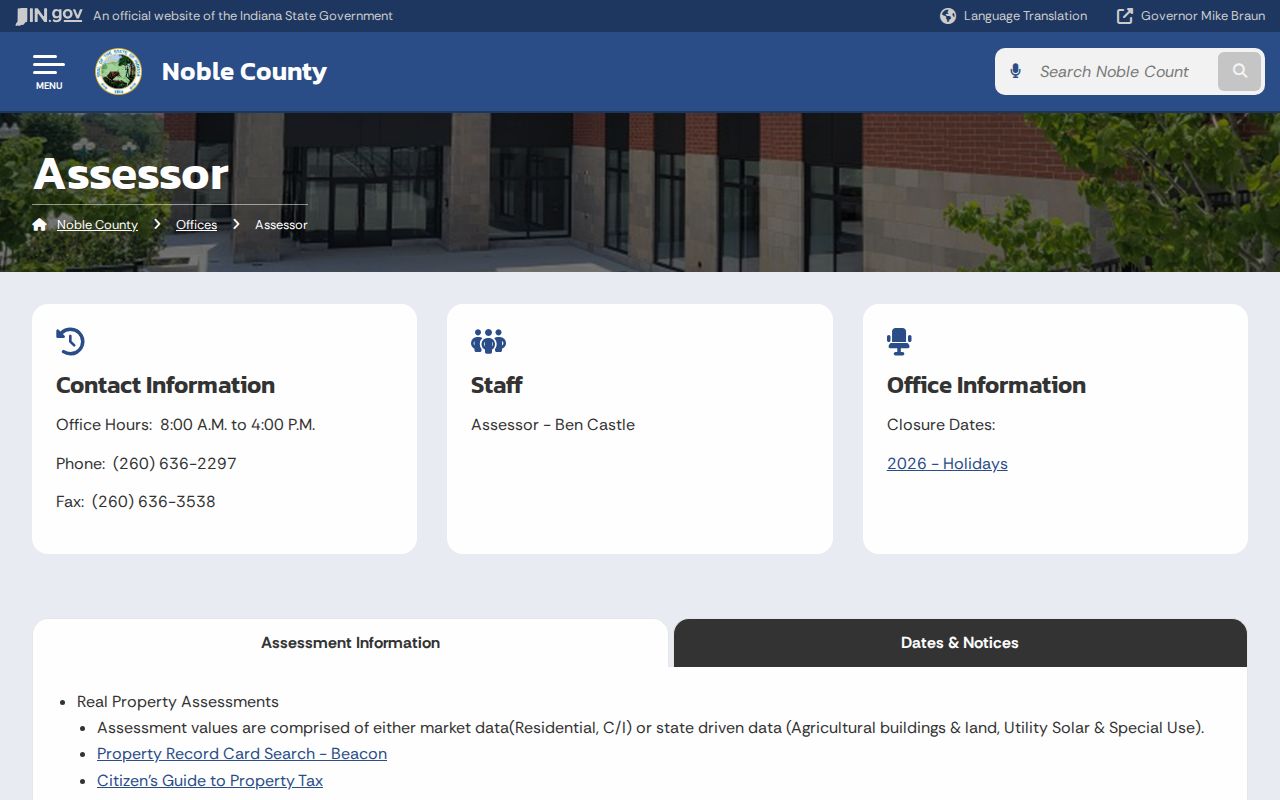
The official county page names the assessment source behind the owner record.
The owner of record is not always the occupant. A home may sit vacant, house family members, or be managed for an entity. The assessment roll does not prove who lives there. For a property question, the listed mailing address is the proper contact clue. Use it with care. Any contact should serve a lawful property purpose only.
Check Noble County Parcel Keys
A street address is only a starting point. Noble County uses an 18-digit State PIN and an 11-digit Tax Bill ID for every parcel. County databases can also carry their own parcel identifiers. The State PIN starts with county code 57 and may appear with punctuation. The Tax Bill ID keeps its leading zero. Either key can separate parcels that share one street address, or expose a land tract with no street number at all.
Beacon offers both Assessor and Surveyor parcel views. The county warns that the layers can disagree because they support different work. When an address fails in the Assessor layer, switch views and search the State PIN or legal tract instead. That helps most after a split or transfer.
Note: Noble County's GIS records may lag a newly recorded transfer or parcel split.
Current Owners After a Sale
A closing does not update every record at once. The deed enters the Noble County Recorder's legal-instrument system first. The Assessor, Auditor, Treasurer, and GIS layers then draw on that transfer for their own work. Each moves on its own schedule. The gap can mislead. Beacon may still show the prior owner.
During the gap, the newest deed in the deed records is the stronger current clue. Read its grantee, the party receiving title. Compare its legal description and parcel reference with Beacon. A matching street address alone is not enough. The Recorder suggests an owner name, legal description, and approximate purchase date. Staff do not perform title or lien searches.
Noble County's Monthly Roster
The GIS Office also publishes a land ownership roster as a PDF. It is arranged by owner name. Each entry includes township and section, legal description, acreage, assessor and auditor identifiers, tax and instrument dates, and a deed number. The roster cross-checks Beacon's live search well.
The county refreshes it monthly, near midmonth. That cycle is why a new owner may show up in the Recorder's index first. The roster also works as a snapshot. You can research by name, tract, or deed number, though it is not a title opinion.
Confirm Noble County's Current Owner
Verification is a two-record check, not a portal tour. Pull the parcel card first. Preserve its strongest parcel key, then test the most recent conveyance in the Noble County Recorder's index. The grantee on the legal instrument should match the owner carried for assessment.
- Open Beacon and search the situs address. Record the owner name, mailing address, State PIN, and last sale clue.
- Use the Recorder's search routes with the name, legal description, and approximate purchase date.
- Read the newest deed's grantee and match the land description or parcel reference, not merely the street text.
- If the deed is newer than the parcel roll, treat the roll as pending an update and ask the custodian when certainty matters.
- Owner of record
- The party named as owner on the active assessment roll.
- Assessment roll
- The county record used to identify parcels and assign assessed values.
- Situs address
- The physical parcel location, which may differ from the owner's mailing address.
- Recording lag
- The time between a deed entering the record and another county layer reflecting it.
Entity Names on Noble Records
The owner field on a Noble County parcel may show an LLC, corporation, trust, or estate. That is not a search error. The deed can vest title in an entity. Beacon carries the entity name for the parcel, so keep it exactly as shown in the Recorder index.
Entity checks reach beyond property records. For a company, Indiana's INBiz business search confirms entity status, business ID, and registered-agent information. The agent is not the landowner. Trust details may stay limited, and estate ownership may need a Noble County probate check.
Mailing Address Versus Situs
A Noble County owner record can carry two addresses that look unrelated. The situs locates the parcel. The mailing address routes tax and assessment notices. Owners often receive mail elsewhere, so the difference is not an error by itself.
Use the mailing address for a measured, property-related letter. Never infer residency from it. Address Confidentiality Program protections may replace a participant's address with a substitute, so a protected or missing address is a privacy stop rather than a reason to hunt for a residence elsewhere.
Check Noble County Transfer Timing
A current-owner answer is only as fresh as its source date. The Recorder takes in the conveyance first. The Auditor, Assessor, Treasurer, and GIS Office each process that event for separate county duties. A deed recorded this week can name a new grantee. Meanwhile Beacon or the monthly ownership roster may still carry the seller. Check the timing before judging. Compare the deed's instrument and recording dates with the roster refresh. Then check the parcel card before calling either name an error.
The GIS Office refreshes its ownership roster around the middle of each month. Instrument dates and deed numbers are included. You can test whether a parcel row has caught up. Beacon warns that recent transfers and splits can lag. If a sale is recent, search the newest deed under the seller. Then search under the buyer too. Match the legal description as well. Hang on to the State PIN and Tax Bill ID. A transfer involving several tracts may not map neatly to one street address.
This matters for a high-stakes purchase. It also matters for an estate matter. End the current owner search with the actual recorded instrument, not a copied screen name. A certified copy authenticates the county record. It is still not a title opinion. Conflicting rights, missing releases, or questions of legal effect need qualified title or legal help.
Use Noble Owner Data Lawfully
Public parcel data supports purchase checks, boundary questions, deed-fraud awareness, estate work, and civic research. It grants no right to pressure or track anyone. If a current owner must be reached about the land, the public mailing address is the right channel. Keep the message tied to that issue alone.
Recent-sale caution. The roll can lag a recent conveyance. The newest recorded deed is the better current-owner clue, but neither search is a title opinion.
Indiana's Access to Public Records Act opens many county records. Statutory exceptions still apply. Confirm the parcel, check the current owner across two official records, and stop where protected information is not published.