
What Noble County Deed Records Reveal
The Noble County Recorder keeps far more than deeds. The office preserves real-estate contracts, affidavits, leases, plats, surveys, liens, mortgages, releases, and powers of attorney, so deed records sit inside a larger family of recorded instruments. Each deed names the parties, describes the land, and fixes the conveyance in the public record. Deed type matters, too, since promises differ by instrument.
| Deed Type | What It Does | Common Use |
|---|---|---|
| Warranty deed | Conveys the stated interest with title covenants written into the instrument. | An ordinary arms-length transfer. |
| Quitclaim deed | Conveys whatever interest the grantor has without the same warranties. | Family transfers or correcting an ownership issue. |
| Personal representative deed | Conveys property under estate authority. | A probate or estate transfer that should be cross-checked with the Clerk. |
| Sheriff's deed | Records a conveyance following an authorized judicial sale. | Connecting a court proceeding to the later land record. |
| Tax deed | Records a conveyance after the statutory tax-sale process. | Following delinquency beyond the notice and sale stages. |
A mortgage or lien encumbers rather than conveys. Check the related releases and assignments before assuming an older mortgage is still open. Some encumbrances live elsewhere. Court judgments, state tax liens, and bankruptcies may sit outside the Recorder's index, so Noble County deed records are one piece of a careful property review.
Search Noble County Deeds Beyond an Address
The Recorder's search guidance points to three dependable inputs. An owner's name, the legal description, and an approximate purchase date narrow a deed search faster than an address ever will. Two online routes exist. The county names Laredo and Tapestry for online access. Public terminals remain available at the Annex for anyone who prefers searching the deed records in person.
| Index input | How to use it | Why it helps |
|---|---|---|
| Grantor or grantee | Try the person's earlier spelling or the exact entity name. | Finds transfers indexed to a party. |
| Legal description | Use lot, block, addition, section, quarter, or roster wording. | Works when a street address does not. |
| Date range | Bracket the approximate purchase or recording date. | Narrows common-name results. |
| Document class | Check deed, mortgage, release, plat, easement, covenant, lien, or affidavit. | Separates a conveyance from related records. |
| Deed or instrument number | Carry the reference from Beacon's land roster into the index. | Targets a known recorded item. |
Note: An address is only a discovery clue, and the Recorder cautions that an address alone may not locate the deed in Noble County.
Noble County's Uneven Online Record Timeline
Online coverage has no single start date. Noble County deeds are searchable back to 1937, while mortgages reach only to 1993, and other instrument classes can differ again. A blank result before a cutoff proves nothing. The conveyance may still exist on paper. Keep going at the Recorder's office with deed books, index volumes, and public terminals, or consult the Indiana State Library's Noble County guide for microfilm and courthouse-record context.
| Period or record | Best first route | Next move |
|---|---|---|
| Deeds, 1937 forward | Laredo/Tapestry index | Open the image when available or order a copy. |
| Mortgages, 1993 forward | Online mortgage index | Search assignments and releases too. |
| Earlier land transfers | Recorder deed books and reverse/direct indexes | Use microfilm or State Library holdings when appropriate. |
| Historic subdivision identity | Recorded plats and dated maps and plat books | Translate the addition, lot, and block into deed-index terms. |
Inside the Noble County Recorder Routes
The Recorder FAQ answers a lot at once. It gathers the online coverage dates, useful search inputs, and office limitations, so read the official Recorder FAQ before choosing between an online and a counter search.
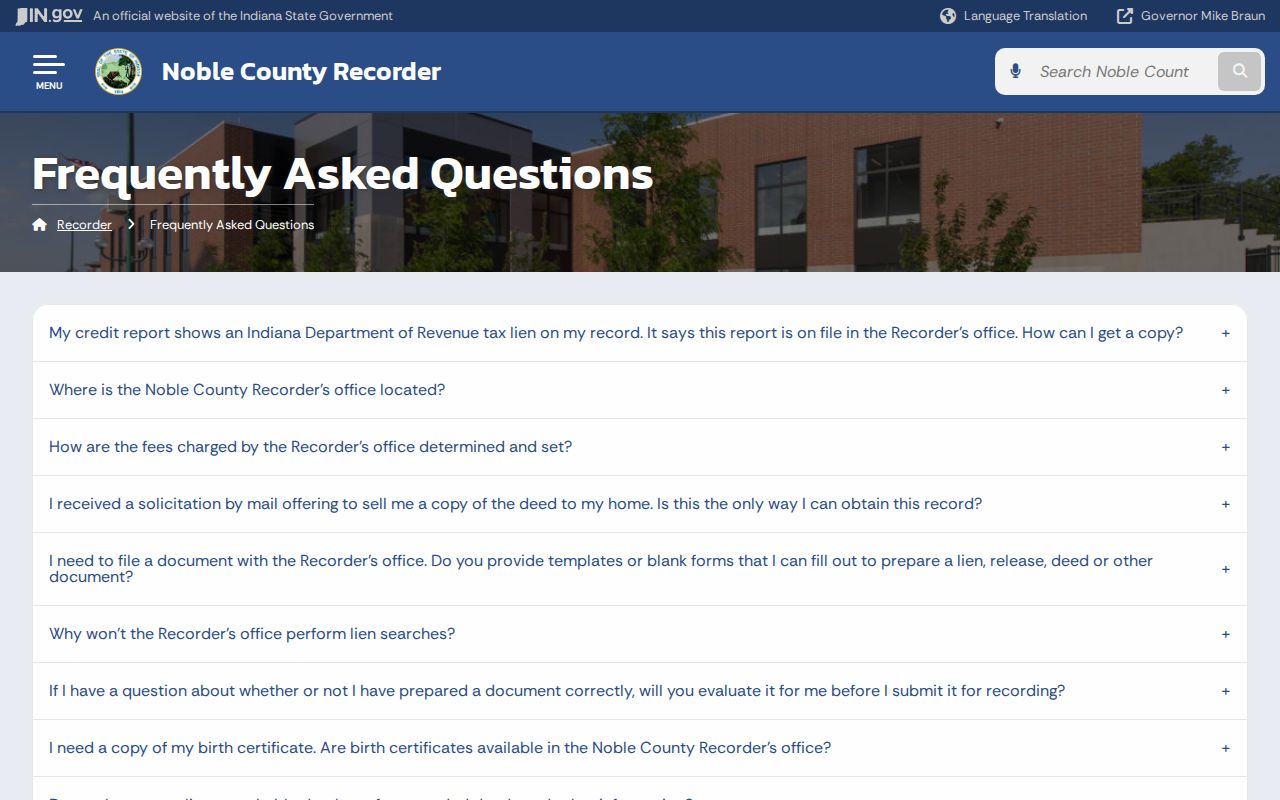
That official page also explains its limits. Staff can point you toward the right deed records, but they cannot perform title work for the public.
Walk Noble County's Grantor-Grantee Index
A grantor-grantee index reads both ways. Run it forward to see what an owner conveyed, or backward to rebuild the acquisitions behind a parcel, recording every party name, legal-description phrase, date, and document reference at each step. Start from one known recent deed.
- Find the present owner's acquiring deed by searching that owner as grantee.
- Read the grantor and exact legal description from the recorded instrument.
- Search that grantor as a grantee during the earlier period, then compare the land description.
- Repeat the sequence; when the online coverage ends, continue in the direct and reverse deed-book indexes.
- Grantor
- The party conveying the interest.
- Grantee
- The party receiving the interest.
- Chain of title
- The chronological sequence of recorded transfers affecting the same land.
- Book/page and instrument number
- References used to retrieve a particular recorded document; preserve whichever appears in the index or roster.
Names alone fail when a person owns several tracts. Match acreage, township and section, addition, lot and block, or metes-and-bounds language at every step. The legal description is the continuity check. A probate order, a name variation, an entity, or a trust can interrupt a simple name-to-name chain.
Build a chain table as you go. Give each row the recording date, grantor, grantee, document type, legal description, and instrument or book-and-page reference. Flag any change in acreage or lot wording. Never force it into the prior tract. When a deed conveys several parcels, identify which description continues the subject land. When an estate, trust, or company appears, preserve the capacity stated in the instrument and use the related probate or business record as corroboration. This cross-check pays off. It makes name spelling changes and partial conveyances visible before they become a false break in the chain.
How a Noble County Conveyance Enters the Record
The recording requirements are specific. A deed needs prepared-by identification, compliant signatures, notarization, prescribed margins, at least 10-point type, and the grantee's physical address on real-property conveyances. Deed transfers also require Auditor endorsement. Those rules explain the markings on a recorded image and why a document may come back before indexing.
Recording is usually fast. Most documents are recorded within 24 hours, and the Recorder describes a turnaround of less than a week, though online presentation can trail office processing. A signed but unpresented deed stays private. Acceptance cuts the other way, too. Recording an instrument does not make the Recorder a judge of title validity or land-use compliance in Noble County.
Recording is not a title opinion. The index reports instruments received by the office; it cannot rule out unrecorded interests or establish marketable title.
A Name Alert for Noble County Recordings
Noble County offers a free Property Fraud Alert. Notice goes out when a subscribed name is recorded. It suits an owner, estate representative, or trustee who wants an early prompt to inspect an unfamiliar filing. The alert is name-based, so sign up through the enrollment service with every personal or entity-name variation that matters.
The alert has limits. It does not block a recording, verify a signature, or cover every encumbrance source, and court judgments, state tax liens, and bankruptcies fall outside its stated coverage. Treat a message as a prompt to act. Pull the instrument and contact the Recorder rather than waiting for a periodic review. That is the alert's real job.
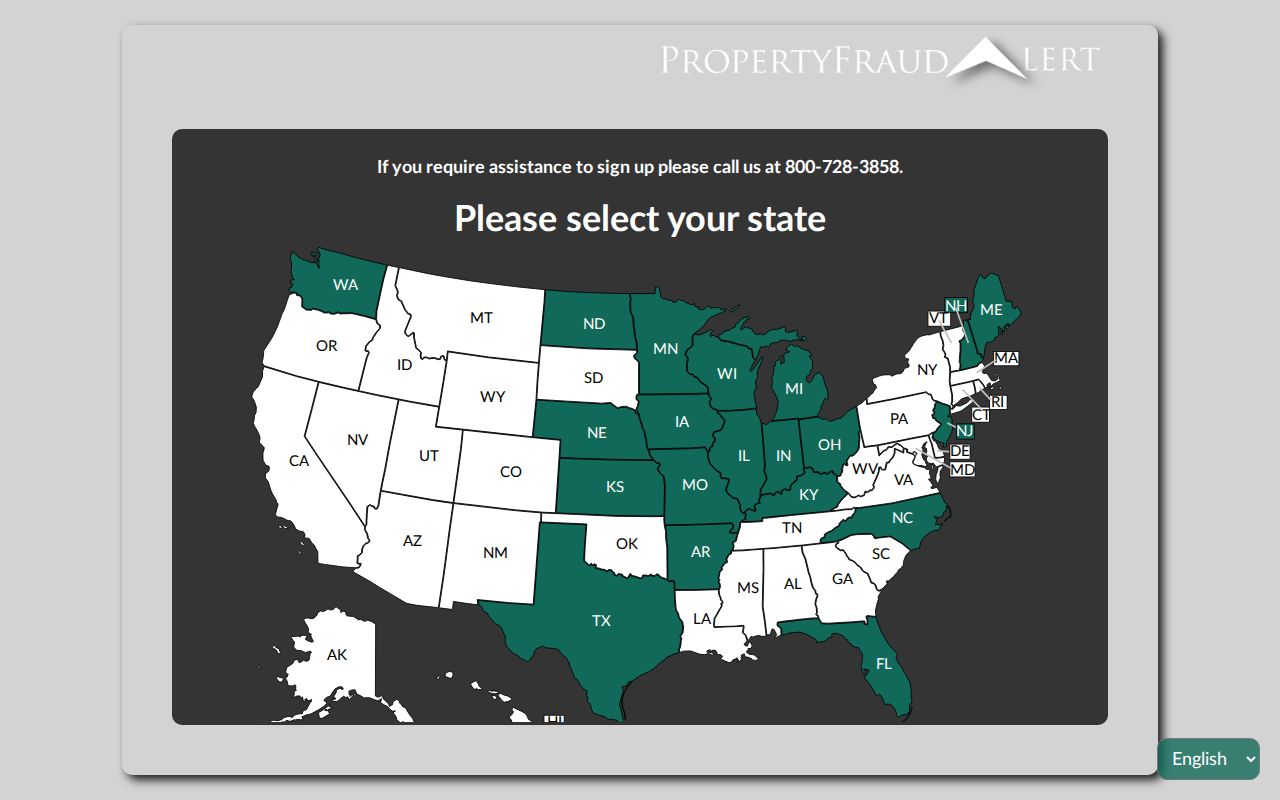
Monitoring keys on a recorded name. It does not track a parcel boundary or guarantee any ownership status.
Obtain a Noble County Deed Copy
Try the online image first. If it is missing or predates digital coverage, visit the Noble County Recorder at 109 N York Street, Annex, Albion, IN 46701, or call 260-636-2672 during weekday hours, 8:00 a.m. to 4:00 p.m. Bring party names, an approximate date, the legal description, and a document reference. The staff supplies access and copies. It will not run the ownership or lien search for you.
Under the posted fee schedule, copies up to 11 by 17 inches run $1 per page. Certification adds $5. Larger GIS pages are $5 each. Recording costs more: $25 for a deed and $55 for a mortgage. The FAQ lists cash or check as accepted payment, so confirm pricing and payment before submitting a document.
The official fee page displays the charges a visitor needs when planning a Noble County deed-record request.
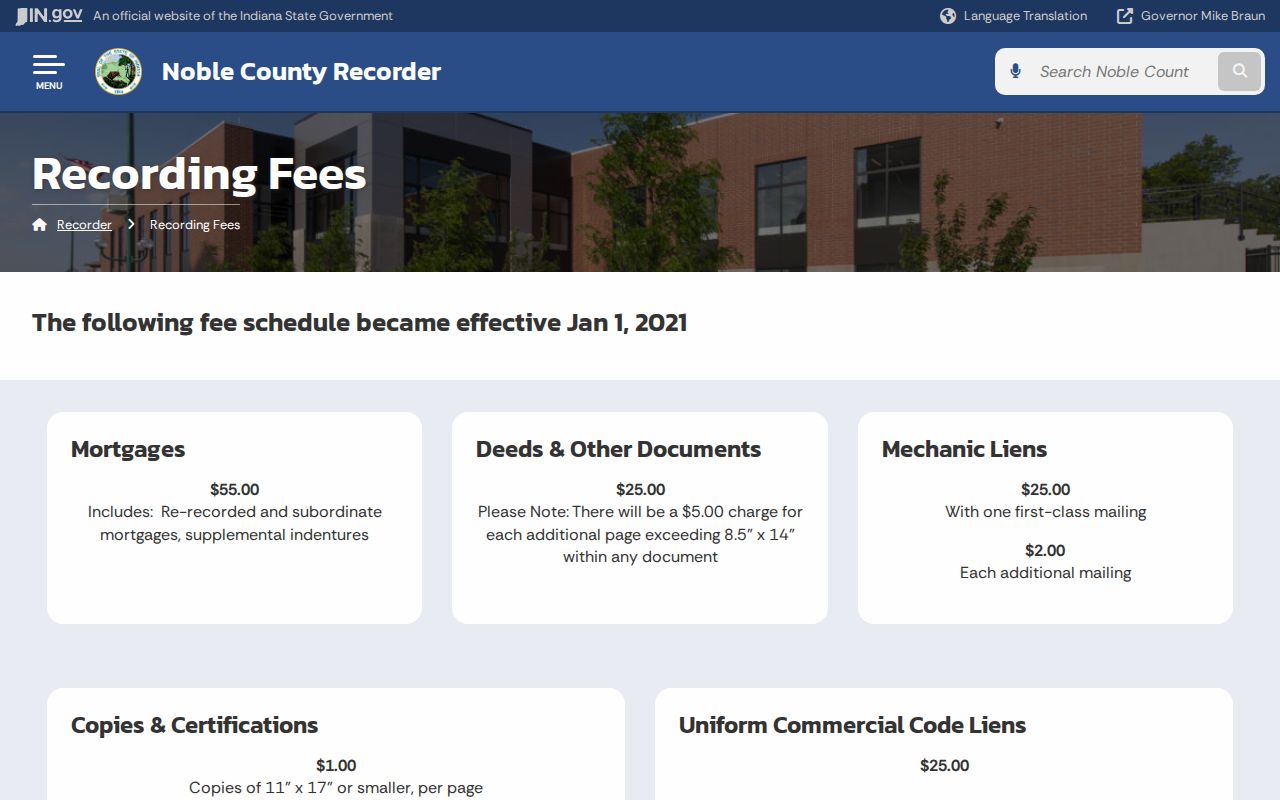
The page separates the cost of recording an instrument from the smaller per-page and certification charges for plain copies.
Recorded, not guaranteed. Noble County deed records show what the Recorder accepted; unresolved or unrecorded interests may exist, and professional title work is needed for a title opinion.